![VERSO_Logo-1.png]](https://helpdesk.verso.de/hs-fs/hubfs/Globale%20Design-Elemente/VERSO_Logo-1.png?height=50&name=VERSO_Logo-1.png)
1. Recording district heating consumption
To calculate district heating emissions, companies must collect precise information on consumption. Similar to electricity, companies obtain the relevant consumption data mainly from invoices from the district heating provider. These invoices contain information on energy consumption and, in some cases, the corresponding emission factors.
Required activity data
The activity data required for this calculation includes:
- District heating consumption: Collect data on the amount of district heating consumed. The most common method is to use purchase records.
- The mass or volume of district heating entering the facility: This data can be based on receipts, purchase records, or data provided directly by the energy supplier and/or the customer's online portal.
2. Accounting for district heating in the Climate Hub
The district heating mix for Germany is already stored in the district heating section. The latest emission factor has already been assigned to this, so you only need to enter your consumption here. If you purchase district heating elsewhere, e.g. from another country, you can add the emission factor using the "+ add own activity" button.
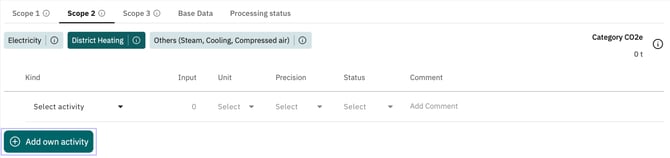
Entering district heating consumption involves several steps:
1. Name the activity
Enter a name for your activity in the field "Name". This field is mandatory.
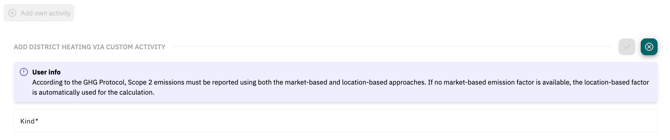
2. Market-based emissions factor
Indicate whether you have a market-based emissions factor.
If "Yes":
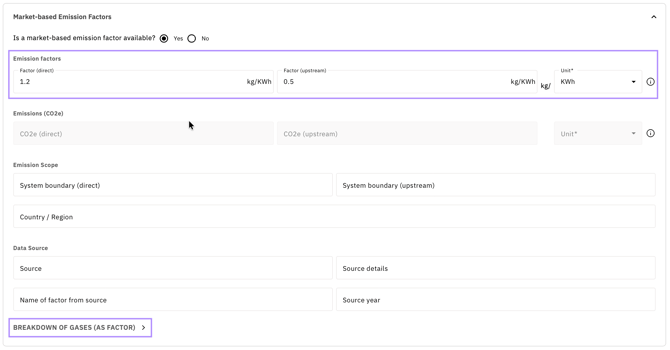
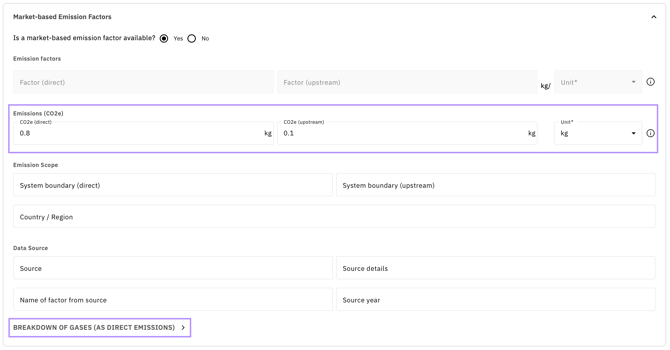
An entry form will open. Provide:
-
direct emissions factor and upstream factor for the market-based approach
or
direct CO2e emissions and upstream emissions for the market-based approach -
unit of the factors (mandatory; selected via dropdown)
-
the source information of the factor
-
optional: specify individual gases in the expanded section
or
If "No":
No market-based entry form will appear. Input continues directly in the location-based section.
In this case, the VERSO Climate Hub will calculate emissions solely using location-based factors – also for the market-based method.
Note: The unit dropdown in the location-based section will then be active, and unit selection is mandatory.

3. Location-based emissions factor
Provide:
-
direct emissions factor and upstream factor for the location-based approach
or
direct CO2e emissions and upstream emissions for the location-based approach -
unit of the factors (via dropdown)
Note: If you previously selected "Yes" when asked about a market-based emission factor, the dropdown menu in this section is disabled and automatically adopts the unit from the market-based section.
If you selected "No", the dropdown menu is active here and selecting a unit is mandatory. -
the source information of the factor
-
optional: individual gases and biogenic emissions in the expanded section
In the section "Fill out for the energy balance (ESRS E1-5)", also specify:
-
the share of renewable energy (%)
-
the share of nuclear energy (%)
This information is required for the E1-5 calculation (see point 4 under Energy consumption). Note: If the activity is specified only via direct CO₂e emissions, ESRS E1-5 cannot be completed correctly. The energy balance accounts exclusively for energy consumption – in this case, E1-5 will remain incomplete.
Further information can be found in the Scope 1 & 2 GHG Inventory Guidance of the GHG Protocol in chapter Scope 2 Emissions from Purchased Energy from page 24.