![VERSO_Logo-1.png]](https://helpdesk.verso.de/hs-fs/hubfs/Globale%20Design-Elemente/VERSO_Logo-1.png?height=50&name=VERSO_Logo-1.png)
The Allocation section in the base data provides support for correctly splitting emissions across products and processes. It is divided into three tabs: Co-products, Waste treatment, and Material recycling. This article first explains the structure of the form, then — for each tab — which methods are available in the respective mode, and finally defines the individual allocation methods.
Availability by enabled standard
Which allocation methods are selectable in the dropdown depends on which standards are enabled for the PCF report. ISO 14067 is always active.
If only ISO 14067 is active, the full range of methods is available. If Catena-X or PACT is additionally enabled, the rulebook restricts the selection: for Waste treatment and Material recycling, the method is fixed, and for Co-products the option "No allocation method applicable" is removed.
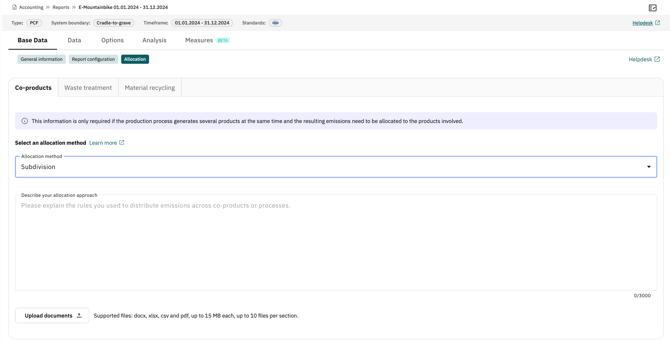
Structure of the Form
Each tab contains the same basic structure:
| 1 |
Selection of the allocation method |
| 2 | Description of the allocation approach used A free-text field allows a description of how the emissions were split, which co-products are involved, which allocation keys were used, and which specific values the allocation is based on. |
| 3 | Upload documents Using the "Upload documents" button, supporting evidence for decision documentation can be uploaded, e.g. a calculation spreadsheet or the rulebook used. Supported formats are docx, xlsx, csv, and pdf, up to 15 MB per file. |
The following figure shows the "Co-products" tab as an example — Waste Treatment and Material Recycling have an identical structure.
Important: Only the tabs relevant to your PCF under consideration need to be filled in.
The following sections explain the various allocation methods according to ISO 14067, Catena-X PCF Rulebook Version 4, and PACT Methodology Version 3. Deviating or additional requirements of individual standards are explicitly noted in each case.
1. Allocation for Co-products
This tab is relevant when the production process generates several products simultaneously — these are referred to as co-products. The available allocation methods must be checked in the prescribed order. Select the method that you applied.
Availability of allocation methods
| Allocation method | ISO 14067 | Catena-X | PACT |
| Subdivision | Available | Available | Available |
| System expansion via substitution | Available | Available | Available |
| Physical allocation | Available | Available | Available |
| Economic allocation | Available | Available | Available |
| No allocation method applicable | Available | - | - |
With Catena-X or PACT enabled: all four allocation methods remain selectable. The option "No allocation method applicable" is removed — for co-products, a method must be assigned when Catena-X or PACT is enabled.
1.1 Subdivision
When to apply? When the process can be technically divided into separate steps, each of which serves only one product. Subdivision avoids allocation entirely and is therefore the option to be checked first in all standards.
The process is divided into sub-processes in such a way that each sub-process can be clearly assigned to one product.
Example: A production line manufactures frames and forks. The welding process for the frame and the bending process for the fork can be accounted for separately — no allocation is needed. The shared painting process, however, cannot be split and requires one of the following allocation methods.
1.2 System expansion via substitution
When to apply? When subdivision is not possible, but the co-product demonstrably displaces a dominant product on the market, and this relationship is recognized industry-wide. In addition, primary data or representative secondary data must be available for the substituted product.
The system boundary is expanded so that the co-product replaces another product on the market. The emissions of this substituted product are deducted as a credit from the PCF of the main product — this eliminates the need for allocation.
Main product PCF = Total process emissions − Emissions of substituted product
When this option is selected, the additional text field "Name of substitution product" appears in the system. Here you enter the name of the product that the co-product replaces.
Example: Blast furnace slag is generated as a co-product in steel production. It replaces cement clinker in the construction sector. The emissions of the avoided clinker production are deducted as a credit from the PCF of the steel, based on industry consensus per the worldsteel methodology.
Important: The main product's PCF must not become negative as a result of the credit.
1.3 Determining the economic value ratio
If neither subdivision nor substitution can be applied, the economic value ratio of the co-products determines which allocation method to use.
Economic value per product = Mass × Market price Ratio = Highest value ÷ Lowest value
The method is determined based on the result:
| Ratio | Interpretation | Next step |
| ≤ 5 | Market values similar | → Step 1.3.1 Physical allocation |
| > 5 | Market values significantly different | → Step 1.3.2 Economic allocation |
Example:
-
Product A: 5 kg × €200/kg = €1,000
-
Product B: 8 kg × €15/kg = €120
-
Ratio: 1,000 : 120 = 8.3 → economic allocation (Step 1.3.2)
1.3.1 Physical Allocation
When to apply? When the economic value ratio of the co-products is ≤ 5, so that the physical property of the products is considered sufficiently representative.
The emissions of a shared process are split among the products involved based on a measurable physical property. Typical allocation keys are mass, unit count, energy, or energy content, e.g.:
Allocation factor = Mass of this product ÷ Total mass of all co-products
Example: A painting facility processes e-mountain bikes (14.5 kg) and e-road bikes (10.2 kg), total mass 24.7 kg. Allocation factor e-mountain bike: 14.5 ÷ 24.7 = 0.587 — i.e., 58.7% of the painting emissions are attributed to the e-mountain bike.
Standard compatibility: Catena-X firmly prescribes the permitted physical reference quantities: produced mass, produced unit count, exergy content, or energy content. For combined heat and power generation (CHP), Catena-X mandates allocation based on generated exergy.
1.3.2 Economic Allocation
When to apply? When the economic value ratio of the co-products is > 5, so that physical allocation would distort economic reality.
The emissions are split based on the economic value of the co-products. The value results from mass multiplied by market price:
Allocation factor = (Mass × price of the product) ÷ (Mass × price of all co-products)
Example:
-
Product A: €1,000
-
Product B: €120
-
Total: €1,120
-
Allocation factor Product A = 1,000 ÷ 1,120 = 0.893
When this option is selected, two additional fields appear. In the "Price type" dropdown, you select the basis on which the allocation was calculated:
- Global market price: The globally applicable market price for the product. First choice per Catena-X, if available.
- Regional market price: A regionally limited market price, e.g. for Europe or North America. To be used if no global price is available or representative.
- Other: Other economic indicators such as production costs or sales price. Only to be used if neither a global nor a regional market price is available.
The "From" and "To" date fields allow you to specify the reference period on which the prices used are based.
Standard compatibility: The order for determining the price type (global → regional → other) is a Catena-X requirement. PACT does not prescribe an order, but requires that only one price type be used per PCF. In the case of strong price fluctuations of more than 100% year-over-year, both PACT and Catena-X require the use of the average price of the last 3–5 years.
2. Waste Treatment
This tab is relevant when waste streams occur during production, e.g. due to offcuts, rejects, or process residues. In the "Allocation method" field, select the method you applied.
Availability of allocation methods
| Allocation method | ISO 14067 | Catena-X | PACT |
| Polluter pays principle | Available | Available | Available |
| Cut-off approach | Available | - | Available |
| No allocation method applicable | Available | - | - |
With Catena-X enabled: the method is fixed to Polluter Pays Principle and cannot be changed. The Cut-off approach and "No allocation method applicable" are not available when Catena-X is enabled.
With PACT enabled: both allocation methods remain selectable. "No allocation method applicable" are not available when PACT is enabled.
2.1 Polluter Pays Principle
When to apply? When the waste is landfilled or incinerated and there is no assured further recovery. This corresponds to the standard case for genuine disposal.
The waste-generating company bears responsibility for all treatment emissions — from collection through transport to final disposal.
Example: In the manufacture of an aluminum frame, 4 g of paint waste per unit is generated and thermally disposed of. All incineration emissions are attributed to the aluminum frame. No credit is applied for recovered heat.
Standard compatibility: Catena-X refers to this principle as the Polluter Pays Principle and mandates it for waste treatment (including incineration with energy recovery); the recovered energy is credit-free in this case. PACT shares the same basic principle for production waste that is disposed of; however, PACT deviates for energy recovery and uses the cut-off approach instead.
2.2 Cut-off Approach
When to apply? When the waste is handed over to an external service provider for disposal at the end-of-waste point, and the disposal emissions are to be attributed to the recipient — not to the generating product system.
The generating product system releases the waste emission-free at the end-of-waste point. All emissions from this point onward are borne by the recipient.
Example: In the manufacture of battery cells, solvent-containing residues are generated and handed over to an external disposal facility for proper chemical treatment. Since the waste is released emission-free at the factory gate, the battery cell bears no emissions for the downstream treatment. The emissions entry for this waste stream is zero.
Standard compatibility: For pure waste treatment with energy recovery (waste-to-energy), the cut-off approach is not provided for in Catena-X — there, the Polluter Pays Principle applies as mandatory. The cut-off approach is primarily prescribed in Catena-X for material recycling (see next section). PACT, on the other hand, mandates the cut-off approach for energy recovery.
3. Material Recycling
This tab is relevant when residual materials or waste from production are recycled. In nearly all cases, the cut-off approach is the standard method.
Availability of allocation methods
| Allocation method | ISO 14067 | Catena-X | PACT |
| Cut-off approach | Available | Available | Available |
| No allocation method applicable | Available | - | - |
With Catena-X or PACT enabled: the method is fixed to Cut-off approach and cannot be changed. Upstream System Expansion and "No allocation method applicable" are not available when Catena-X or PACT is enabled.
Cut-off Approach
When to apply? When the material is recycled externally and is not part of the company's own product system, or when a cradle-to-gate perspective applies.
The responsibility of the generating product system ends at the end-of-waste point. From the point of hand-over, the generating system no longer bears any emissions. At the same time, it receives no credit for the fact that the material replaces primary production elsewhere.
Example: A bicycle manufacturer hands over 180 g of aluminum shavings per frame to an external recycler. Emissions for transport, melting, and processing are borne by the recipient of the secondary aluminum. The emissions entry in the frame's PCF is zero — a credit for replaced primary production is likewise not applied.
Standard compatibility: The cut-off approach is the prescribed standard method across all three standards. Preparatory steps for recycling are generally attributed, under Catena-X, to the receiving product system (the one using the recycled material); for pre-consumer scrap, however, the preparatory steps occurring at the waste generator are to be accounted for by the generator (cut-off rules apply).