![VERSO_Logo-1.png]](https://helpdesk.verso.de/hs-fs/hubfs/Globale%20Design-Elemente/VERSO_Logo-1.png?height=50&name=VERSO_Logo-1.png)
To increase the informative value of your GHG inventory, you can assess the data quality of your emission factors and activity data in the Climate Hub.
Based on this, the system calculates the uncertainty of your emission results. This allows you to present more transparently how reliable your calculations are.
This feature helps you to:
-
systematically document the quality of your data
-
make uncertainties in your CO₂ inventory transparent
-
better meet requirements from the GHG Protocol, SBTi and reporting
-
identify improvement potential in your data collection
Overview: How the uncertainty assessment works
The uncertainty of your emission calculation results from two factors:
- Uncertainty of emission factors
- Uncertainty of activity data
Both are assessed separately in the Climate Hub. You can then view the total uncertainty of the emission factors, the total uncertainty of the activity data, and the combined total uncertainty.
1. Uncertainty of emission factors
For each emission factor, you can assess data quality based on four dimensions:
-
Precision
-
Geographical representativeness
-
Technological representativeness
-
Temporal representativeness
For each of these dimensions, the rating levels "very good", "good", "fair" and "poor" are available. A definition of the individual rating levels can be found in the following sub-sections 1.1 – 1.4.
You can specify the rating when creating a new activity using the "Add own activity" button. Alternatively, you can enter and edit the data quality retrospectively using the pencil icon in the relevant activity row.
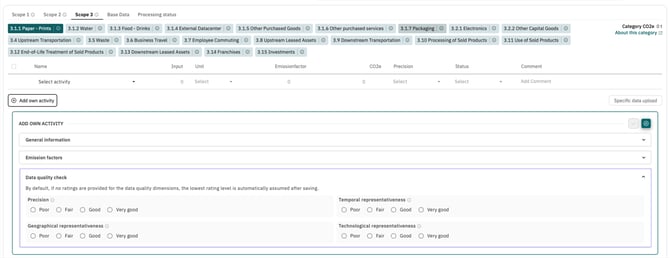
Note: If no assessment is provided, the system automatically applies the lowest rating level.
1.1 Precision
This dimension assesses how reliable and data-based the emission factor is.
| Rating level | Definition |
| Very good | Supplier-specific emission factor |
| Good | Secondary emission factor from a database based on physical quantities or consumption |
| Fair | Secondary emission factor from a database based on the cost of a product or service |
| Poor | Source or methodology of the emission factor is unclear |
1.2 Temporal representativeness
This dimension assesses how up-to-date the emission factor is compared to the reporting year.
| Rating level | Definition |
| Very good | < 3 years deviation |
| Good | < 6 years deviation |
| Fair | < 10 years deviation |
| Poor | > 3 years deviation |
1.3 Geographical representativeness
This dimension assesses how well the region of the emission factor matches the assessed region.
| Rating level | Definition |
| Very good | Emission factor comes from the same region, e.g. from Germany for electricity consumption in Germany |
| Good | Emission factor comes from a comparable region, e.g. from Austria or France for electricity consumption in Germany |
| Fair | Emission factor comes from a significantly different region, e.g. from India for electricity consumption in Germany |
| Poor | Region or country not known |
1.4 Technological representativeness
This dimension assesses how well the underlying technology corresponds to the actual process.
| Rating level | Definition |
| Very good | Emission factor was determined using the same technology that is actually used, e.g. an emission factor for electric cars for driving an electric car |
| Good | Emission factor was determined using a similar technology, e.g. an emission factor for diesel cars for driving a petrol car |
| Fair | Emission factor is based on a generic sector value for the entire industry, without reference to a specific technology, e.g. a transport emission factor regardless of the transport mode |
| Poor | Technology is unknown |
2. Uncertainty of data quality
In addition to emission factors, you can also assess the quality of your activity data. This is done via the “Precision” column in each activity row:

A definition of the individual rating levels can be found in the table below:
| Rating level | Definition | Precision |
| Document / Measurement | Data is based on actual measurements or documented records, e.g. electricity consumption from an annual utility bill. | -4.8 to +5.0% |
| Extrapolation | Data is extrapolated based on available information, e.g. employee commuting behavior based on a survey. | -13.0 to +15.0% |
| Spend-based | Data is based on costs instead of actual quantities, e.g. expenses for a cleaning service. | -23.1 to +30.0% |
| Estimate | Data is based on rough assumptions, e.g. estimated waste volume without measurement. | -39.4 to +65.0% |
3. Output of uncertainty metrics
Based on your assessments, the Climate Hub automatically calculates several data quality and uncertainty metrics. These are displayed both per structural element and aggregated across all structural elements.
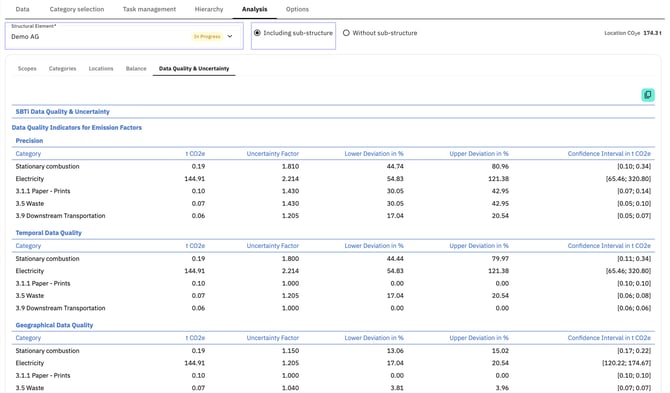
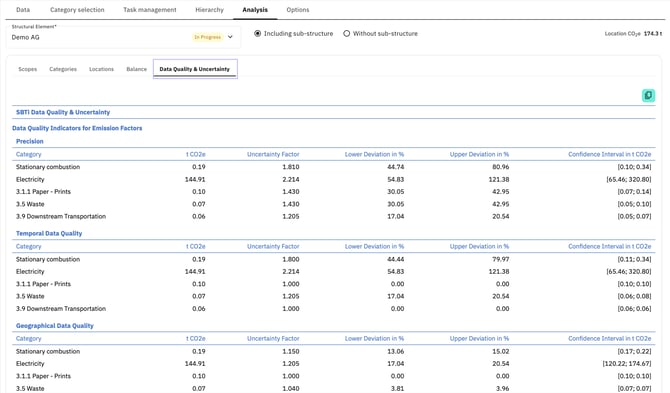
You can find the results in the report under the "Analysis" tab and the "Data Quality & Uncertainty" sub-tab:
3.1 Data quality metrics for emission factors
This section shows the data quality of your emission factors by category for the four dimensions:
Precision:
Describes how reliable the emission factors used generally are.
Temporal data quality:
Shows how well the time frame of the emission factors aligns with your reporting period.
Geographical data quality:
Assesses how well the geographical origin of the emission factors matches your actual region.
Technological data quality:
Indicates how well the underlying technology of the emission factors corresponds to your actual process.
The following key figures are calculated for each dimension:
Multiplicative uncertainty factor:
Shows how much your calculated emissions can deviate upwards or downwards.
Example:
An uncertainty factor of 1.2 means that your actual emissions can be up to 20% higher or lower.
Upper and lower deviation of the CO₂e emissions:
Shows the percentage deviation of your emissions, either above or below the target.
Confidence interval:
Indicates the possible deviation in your emissions in absolute terms.
3.2 Uncertainty metrics
This section shows
-
the aggregated data quality of your emission factors across all dimensions,
-
the total uncertainty of the activity data, and
-
the combined total uncertainty derived from emission factors and activity data.
Total uncertainty of emission factors:
Shows the combined uncertainty of all emission factors, considering all four quality dimensions.
Total uncertainty of activity data:
Shows the uncertainty of the activity data used. A low uncertainty indicates that your data is mainly based on reliable primary data. A high uncertainty indicates that estimates were used.
Total uncertainty of emission factors and activity data:
Shows the overall uncertainty of your emission calculation by combining both emission factor and activity data uncertainties.
Here too, the following metrics are displayed for each category:
-
Multiplicative uncertainty factor
-
Upper and lower limits
-
Confidence interval.
Attention:
- For Scope 2 categories, you must specify the rating dimensions separately for the market-based and location-based approaches. The uncertainty metrics are then reported separately for both approaches.
-
Currently, only the direct emission factor is included in the uncertainty assessment. The upstream emission factor is not yet considered.
3.3 Breakdown of key figures by structural element and in aggregate
All key figures are displayed both by structural element and aggregated across all structural elements.
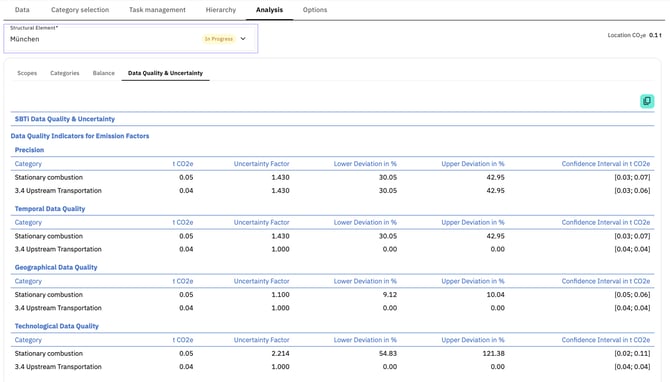
View key figures by structural element:
To view the key figures by structural element, select the desired element from the "Structural element" drop-down menu. The key figures will then be displayed for the selected structural element.
Display aggregated metrics:
To view aggregated data across all structural elements, navigate to the top-level hierarchy. Then click the “Include sub-structure” button.